

Welcome, fellow enthusiasts, to a realm where practicality takes a backseat, and the pursuit of absolute performance reigns supreme. We’re embarking on a quest to conceptualize the ultimate “God-Tier” custom PC – a machine built without compromise, pushing the boundaries of what’s possible with consumer hardware. But this isn’t just a theoretical exercise. Our challenge is to source every single component for this dream machine exclusively through the vast digital aisles of Amazon.com (US), reflecting what a determined builder can actually acquire from this major retailer today. Prepare yourself for a journey into the heart of extreme PC building, navigating the latest technology, market realities, and the sheer thrill of creating something extraordinary.
- The Dream of “God-Tier”: Pushing Performance Beyond Limits
- Anatomy of a Behemoth: Essential Components Explained
- The Chosen Few: Top-Tier Components on Amazon.com (Updated for US Market)
- Constructing the Titan: Compatibility, Cost & Considerations ⚙️
- The View from the Top: Pros, Cons, and Uses 🚀
- Conclusion: Is the “God-Tier” Dream for You? 🤔
The Dream of “God-Tier”: Pushing Performance Beyond Limits
Defining the “God-Tier” Philosophy
In the world of custom PCs, there exists a category that transcends sensible budgets, power efficiency concerns, and mainstream needs. This is the domain of the “God-Tier” PC. It represents a relentless pursuit of the absolute best consumer hardware available at a given moment, assembled into a machine that prioritizes raw power above all else.
This isn’t about finding the best value or making a rational choice. It’s about pure, unadulterated performance – investing in cutting-edge technology to achieve the highest possible frame rates in every game, load massive files instantaneously, and handle the most demanding creative or computational workloads without breaking a sweat. It’s the physical manifestation of a PC enthusiast’s dream, a testament to the limits of current technology, built simply because it can be.
The Amazon.com Quest: Real-World Sourcing
Turning this dream into reality involves more than just listing the most powerful components on paper. Our “God-Tier Plan” introduces a crucial layer of practicality (and challenge): sourcing every part through Amazon.com (US). This constraint forces us to confront the realities of the consumer market – what can an enthusiast truly purchase from one of the world’s largest online retailers right now?
Navigating Amazon for bleeding-edge hardware presents unique hurdles. Newly launched flagship components, like the processors and graphics cards we’ll be discussing, often face limited initial stock. Listings might be dominated by third-party sellers charging significant premiums over the manufacturer’s suggested retail price (MSRP). Finding specific models from preferred partners can sometimes feel like a treasure hunt. This dynamic often creates a gap between the theoretical ultimate PC and the one actually buildable through Amazon at any given time. Top-tier parts might be listed but unavailable, or only offered at prices that make even the “cost-no-object” builder pause. This guide embraces that challenge, selecting the best components listed on Amazon.com while acknowledging the potential for availability issues and inflated market pricing that are inherent to this sourcing method.
Who Is This Build For?
Who dares to dream this expensive dream? The audience for a “God-Tier” PC is specific:
- Hardcore Gamers: Individuals demanding the absolute highest frame rates at maximum graphical fidelity, often at 4K or even 8K resolutions, with ray tracing effects cranked to the max. They seek the smoothest, most immersive experience possible.
- Professional Creators & Power Users: Those working with massive datasets and computationally intensive tasks – 8K video editors, 3D rendering artists, AI developers training models locally, scientists running complex simulations. For them, processing time directly impacts productivity.
- PC Enthusiasts: The dedicated hobbyists driven by a passion for technology, the desire to own the “best of the best,” and the satisfaction of building and benchmarking a machine at the pinnacle of performance.
For these individuals, a PC is far more than a tool; it’s an object of passion, a platform for their craft or entertainment, and a powerful statement piece.
Anatomy of a Behemoth: Essential Components Explained

To construct this technological titan, we need a carefully curated selection of components, each playing a vital role and working in concert to deliver ultimate performance. Let’s break down the key players:
- CPU (The Command Center): The Central Processing Unit is the brain of the operation. It dictates overall system responsiveness and is crucial for performance in demanding applications, complex simulations, and certain aspects of gaming.
- GPU (The Visual Powerhouse): The Graphics Processing Unit is the heart of any high-end gaming or visual creation rig. It handles the immense task of rendering complex scenes, accelerating AI computations, and driving high-resolution displays at high frame rates.
- Motherboard (The Central Hub): This is the foundation connecting everything. A high-end motherboard provides stable power delivery essential for power-hungry components, offers the necessary high-speed connectivity (like PCIe 5.0), and allows for future expansion.
- RAM (High-Speed Workspace): Random Access Memory acts as the system’s short-term memory. For a God-Tier build, we need extremely fast, high-capacity RAM to keep the powerful CPU and GPU fed with data, ensuring smooth multitasking and responsiveness in demanding scenarios.
- Storage (Lightning-Fast Access): Forget traditional hard drives or even slower SSDs. Ultra-fast NVMe (Non-Volatile Memory Express) SSDs, specifically those leveraging the latest PCIe 5.0 interface, are key to eliminating loading time bottlenecks for the OS, applications, and games.
- PSU (The Unyielding Power Source): The Power Supply Unit is the lifeline, delivering stable and sufficient wattage to all components. With extremely power-hungry CPUs and GPUs, a high-capacity, high-efficiency, and reliable PSU is absolutely critical.
- Case (The Protective Showcase): More than just a box, the case houses all the expensive hardware, provides the necessary structure for airflow management (critical for cooling), and contributes significantly to the build’s overall aesthetic appeal.
- Cooling (Mastering the Thermals): Top-tier components generate immense heat. An equally top-tier cooling system (either high-end air or large liquid AIO) is non-negotiable to prevent thermal throttling, maintain peak performance, and ensure the longevity of the hardware.
The Chosen Few: Top-Tier Components on Amazon.com (Updated for US Market)
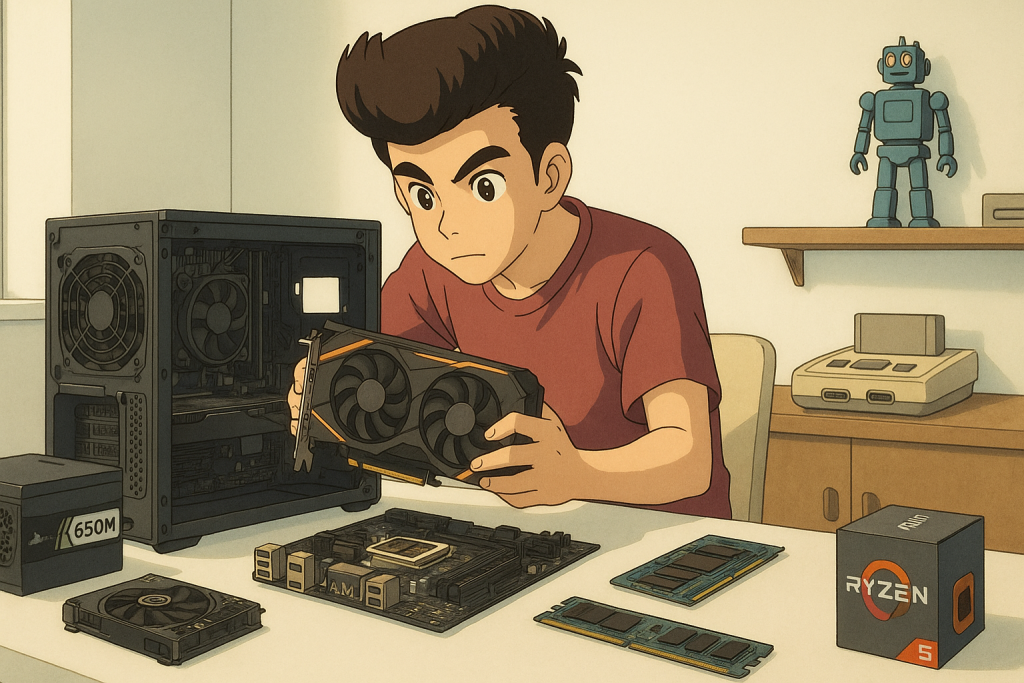
Now, the exciting part: selecting the absolute best components currently listed on Amazon.com (US) for our God-Tier build.
Important Note on Amazon Pricing & Availability:
Before we dive in, a crucial reminder: sourcing the absolute latest flagship hardware through Amazon.com presents unique challenges. Components like the AMD Ryzen™ 9 9950X3D or NVIDIA® GeForce RTX™ 5090 may appear on the site, but often with caveats. Initial stock can be extremely limited, leading to “out of stock” notices or long shipping delays. Furthermore, especially shortly after launch, prices listed by third-party sellers can be significantly inflated, sometimes drastically exceeding the official MSRP. For instance, while the Ryzen 9 9950X3D has an MSRP of $699, Amazon listings might show prices closer to $900. The RTX 5090, with a theoretical MSRP around $2000, frequently appears on Amazon for anywhere between $3,500 and a staggering $4,800 or more.
This reality means the “God-Tier PC buildable via Amazon” might differ slightly from a purely theoretical “best possible build.” Availability might force a slight step down, or the price premium might become truly extreme. This guide selects the highest-performing components listed and theoretically purchasable on Amazon.com, reflecting these market conditions. The prices cited are estimates based on observed Amazon listings around the time of writing (contextually April 2025) and are subject to significant fluctuation. Building a God-Tier PC through Amazon is as much about navigating these market dynamics as it is about selecting the hardware itself.
CPU: Processing Supremacy 🧠
The CPU is the nerve center of the PC. For ultimate performance, especially in gaming, the choice often comes down to leveraging specialized technology or maximizing raw core power.
- Top Tier Option (AMD): AMD Ryzen™ 9 9950X3D
- Specifications: This processor sits at the apex of AMD’s consumer lineup, built on the Zen 5 architecture. It boasts 16 cores and 32 threads, a base clock of 4.3 GHz boosting up to 5.7 GHz, and crucially, AMD’s 3D V-Cache technology, bringing the total L2+L3 cache to a massive 144MB. It utilizes the AM5 socket, supporting PCIe 5.0 and DDR5 memory, with a TDP of 170W.
- Performance Context: The defining feature is the 3D V-Cache, which provides a significant performance uplift in many games, often making it the fastest gaming CPU available. While its 16 cores offer excellent productivity performance, its primary advantage lies in gaming scenarios where the large cache minimizes latency. It aims to beat competitors like Intel’s flagship in gaming benchmarks.
- Amazon Availability/Price: The 9950X3D is listed on Amazon.com. However, its $699 MSRP is often not reflected in initial listings. Prices from third-party sellers or even Amazon itself can be significantly higher, potentially reaching $890 or more, especially during periods of high demand or low stock. Availability might be intermittent. Expect a range of ~$700 – $900+.
- Top Tier Option (Intel): Intel® Core™ Ultra 9 285K
- Specifications: Intel’s flagship for the Arrow Lake generation features a 24-core configuration (8 Performance-cores + 16 Efficient-cores) but notably lacks hyper-threading on the P-cores, resulting in 24 threads. It utilizes the new LGA 1851 socket, boosts up to 5.7 GHz, has 36MB of L3 cache, and a Processor Base Power (PBP) of 125W, though actual power draw under load will be higher. It supports PCIe 5.0, DDR5, and includes an NPU (Neural Processing Unit) for AI tasks.
- Performance Context: This CPU offers formidable multi-threaded performance thanks to its high core count, making it excellent for productivity tasks. Its single-threaded performance is also top-tier due to high clock speeds. While extremely capable in gaming, benchmarks and the historical advantage of AMD’s 3D V-Cache suggest it likely trades blows or falls slightly behind the 9950X3D in average gaming performance. The NPU offers potential future benefits for AI-accelerated applications.
- Amazon Availability/Price: The Core Ultra 9 285K is listed on Amazon.com, sometimes as an OEM pack or in bundles. Pricing appears more stable than the 9950X3D initially, hovering around ~$560 – $620, closer to its theoretical MSRP.
- Alternative Intel: Intel® Core™ i9-14900K
- Specifications: The flagship of the previous Raptor Lake Refresh generation, offering 24 cores (8P+16E) with 32 threads (P-cores have hyper-threading), boosting up to an impressive 6.0 GHz on the LGA 1700 socket. It also has 36MB L3 cache and a 125W PBP.
- Performance Context: Still a powerhouse CPU with excellent multi-threaded and single-threaded performance. Gaming performance is very high, though generally edged out by AMD’s X3D chips in averages.
- Amazon Availability/Price: Widely available on Amazon.com at a significantly lower price point than the newer flagships, typically around ~$440 – $450.
- Why it’s the Best (Rationale):
- Ryzen 9 9950X3D: Chosen for its unmatched gaming performance derived from the massive 3D V-Cache. The 16 Zen 5 cores provide excellent multi-threaded capability for demanding productivity tasks, even if slightly behind pure core-count leaders in specific benchmarks. The modern AM5 platform ensures support for PCIe 5.0 and fast DDR5.
- Core Ultra 9 285K: Offers exceptional multi-threaded throughput due to its 24 cores, combined with very high clock speeds for strong single-core performance. The inclusion of an NPU adds a layer of future-proofing for AI workloads. It represents Intel’s latest platform technology.
- Build Choice: AMD Ryzen™ 9 9950X3D
- Justification: The “God-Tier” ethos often prioritizes the absolute peak gaming experience. The Ryzen 9 9950X3D, thanks to its specialized 3D V-Cache, consistently delivers the highest gaming frame rates in titles that benefit from the extra cache. While the Core Ultra 9 285K might hold an edge in some purely multi-threaded productivity benchmarks, the 9950X3D’s 16 cores are still immensely powerful for creation tasks. Assuming it can be secured on Amazon, even at a premium, its gaming supremacy makes it the prime choice for this ultimate build. If it proves utterly unobtainable or its price becomes truly absurd (e.g., well over $1000), the Core Ultra 9 285K becomes the logical alternative, offering a fantastic blend of productivity and gaming power. For a pure gaming focus on a slightly tighter (relatively speaking) budget, the Ryzen 7 9800X3D offers much of the same gaming prowess for less cost.
GPU: Unrivaled Graphics 🚀
The graphics card is arguably the defining component of a God-Tier gaming PC, responsible for rendering breathtaking visuals at high resolutions and frame rates.
- Top Tier Option: NVIDIA® GeForce RTX™ 5090
- Specifications: NVIDIA’s flagship consumer GPU based on the Blackwell architecture. It packs an immense 21,760 CUDA cores, paired with a massive 32GB of ultra-fast GDDR7 memory on a wide 512-bit bus. It utilizes the PCIe 5.0 interface and features enhanced Ray Tracing (4th Gen RT Cores) and AI capabilities (5th Gen Tensor Cores, DLSS 4). It’s a power-hungry card, with a typical Total Graphics Power (TGP) around 575W.
- Performance Context: This GPU sits uncontested at the top of performance charts. Benchmarks show substantial performance gains over the already powerful RTX 4090, often ranging from 20% to over 50% depending on the game and settings. It’s designed to handle 4K and 8K gaming at maximum settings, dominate ray-traced workloads, and accelerate demanding AI tasks.
- Amazon Availability/Price: Here lies the biggest hurdle. The RTX 5090 is listed on Amazon.com from various partners (MSI, Gigabyte, ZOTAC, ASUS) and as a Founders Edition. However, availability is often scarce (“Only 1 left in stock”), and prices are exorbitant. While the MSRP is expected to be around $1,999 – $2,000, actual Amazon prices typically range from $3,500 to $4,800+. This massive premium reflects the extreme demand, limited initial supply, and third-party market dynamics.
- Alternative: NVIDIA® GeForce RTX™ 4090
- Specifications: The previous generation’s king, featuring 16,384 CUDA cores, 24GB of GDDR6X memory on a 384-bit bus, using PCIe 4.0, with a 450W TGP.
- Performance Context: Still an incredibly potent GPU, capable of excellent 4K gaming performance, second only to the 5090.
- Amazon Availability/Price: More established presence on Amazon, but remains very expensive, often found between $2,700 and $3,800+, still well above its original MSRP.
- Why it’s the Best (Rationale): The RTX 5090 leverages NVIDIA’s latest Blackwell architecture, offers a huge leap in core count and memory capacity/bandwidth, delivers significantly improved ray tracing and AI performance (including DLSS 4), and supports the PCIe 5.0 standard. Benchmark results unequivocally place it as the fastest consumer graphics card available.
- Build Choice: NVIDIA® GeForce RTX™ 5090 (Partner Model)
- Justification: In a build defined by the pursuit of the absolute best, there is no substitute for the RTX 5090. Despite the astronomical price premium and the potential difficulty in securing one through Amazon, its performance leadership makes it the mandatory choice for a true God-Tier machine. The specific partner model (e.g., ASUS ROG Strix/Astral, MSI Suprim/Gaming Trio, Gigabyte AORUS/Gaming OC) would depend on real-time availability, specific cooling solutions, and aesthetic preference, fully accepting the inflated cost as part of the “Amazon God-Tier” tax.
Motherboard: The Ultimate Foundation 🔗
The motherboard is the crucial backbone, needing robust power delivery and the latest connectivity to support our chosen flagship components.
- Top Tier Options (AMD – for 9950X3D): High-End X870E Motherboards
- Examples: ASUS ROG Crosshair X870E Hero, ASUS ROG Strix X870E-E Gaming WiFi, NZXT N9 X870E.
- Specifications: These boards utilize AMD’s top-tier X870E chipset, designed specifically for the Ryzen 9000 series. Key features include extremely robust power delivery systems (often 18+ power stages, like the Hero’s 18+2+2 or N9’s 20+2+1) to handle high-TDP CPUs and overclocking. They offer essential PCIe 5.0 support for both the primary x16 slot (for the GPU) and multiple M.2 slots (for NVMe SSDs). Support for high-speed DDR5 RAM (8000MHz+ claimed) is standard, along with the latest connectivity like Wi-Fi 7, multi-gigabit Ethernet (5GbE or 10GbE), and USB4 ports. Premium build quality, extensive heatsinks for VRMs and M.2 drives, and user-friendly features like Q-Release are expected.
- Amazon Availability/Price: These high-end X870E boards are available on Amazon. The ROG Strix X870E-E is around $470, the NZXT N9 X870E is about $500, and the flagship ROG Crosshair X870E Hero commands a price around $690. Expect a range of $450 – $700+.
- Top Tier Options (Intel – for 285K): High-End Z890 Motherboards
- Examples: ASUS ROG Maximus Z890 Hero, ASUS ROG Maximus Z890 Apex, ASUS ROG Maximus Z890 Extreme.
- Specifications: Representing the peak of Intel’s platform for the Core Ultra Series 2 (Arrow Lake) processors. These boards feature even more extreme power delivery (often 22+ stages, e.g., Z890 Hero’s 22+2+1+2) for maximum stability and overclocking potential. They provide comprehensive PCIe 5.0 support for graphics and multiple M.2 SSDs, support for the fastest DDR5 memory kits, and cutting-edge connectivity including Wi-Fi 7, fast Ethernet, and often Thunderbolt 4 or 5 ports. Premium audio, extensive cooling, and diagnostic tools are standard.
- Amazon Availability/Price: Z890 flagships are listed on Amazon. The ROG Maximus Z890 Hero is priced around $590-$635. The Z890 Apex appears to be around $710 based on bundle pricing, and the Z890 Extreme is listed near $800. Expect $600 – $800+.
- Why it’s the Best (Rationale): A top-tier motherboard is essential not just for compatibility, but to unlock the full potential of the chosen CPU and GPU. The robust power delivery ensures stability under the extreme loads imposed by the 9950X3D and RTX 5090, especially if overclocking is considered. PCIe 5.0 support is mandatory to provide maximum bandwidth to both the graphics card and the NVMe SSD. Support for ultra-fast DDR5 RAM (8000MHz+) allows memory performance to keep pace. Comprehensive high-speed I/O (USB4, Wi-Fi 7, 5GbE/10GbE) is expected for a build of this caliber. Finally, premium build quality, effective thermal solutions for critical components (VRMs, M.2 drives), and advanced BIOS features justify the cost in an ultimate build.
- Build Choice (AMD): ASUS ROG Crosshair X870E Hero
- Justification: This board represents the pinnacle of the AM5 platform currently available on Amazon, perfectly suited for the Ryzen 9 9950X3D. Its 18+2+2 power stage design is more than capable of handling the CPU’s demands. It offers ample PCIe 5.0 lanes for the RTX 5090 and at least one Gen5 M.2 SSD, with a total of five M.2 slots providing extensive storage expansion. Connectivity is cutting-edge with Wi-Fi 7 and USB4. While the NZXT N9 X870E offers compelling specs and a clean look for less money, the ROG Hero traditionally provides a slightly more feature-rich package, potentially more robust BIOS options for extreme tuning, and a premium aesthetic that aligns well with the God-Tier concept. Its higher price (~$690) is accepted within the context of this cost-no-object build.
RAM: Extreme Speed Memory ⚡
For a system this powerful, the RAM needs to be both incredibly fast and sufficiently large to avoid becoming a bottleneck.
- Top Tier Option: DDR5 48GB (2x24GB) or 64GB (2x32GB) Kit @ 8000MHz+ CL40 or lower
- Examples: G.Skill Trident Z5 (RGB, Royal, Neo variants) are frequently seen at the highest speeds, like 8000MHz CL40 and even 8400MHz CL40. Corsair Vengeance/Dominator, Patriot Viper Xtreme 5, TeamGroup T-Force Delta, and Lexar ARES also offer kits in the 8000MHz range, often with CL38 or CL40 timings.
- Specifications: The goal is the highest stable clock speed available combined with the lowest possible CAS Latency (CL). Kits operating at 8000MHz, 8200MHz, and 8400MHz are listed on Amazon. At these speeds, CL40 is a good target, though some 8000MHz kits achieve CL38. The choice between 48GB (2x24GB) and 64GB (2x32GB) often comes down to stability; 2x24GB kits are frequently able to reach higher stable frequencies. Compatibility must be verified against the motherboard’s Qualified Vendor List (QVL), and the XMP (Intel) or EXPO (AMD) profile must be enabled in the BIOS to achieve rated speeds.
- Performance Context: Higher memory frequencies directly translate to increased bandwidth and reduced latency, which can significantly boost CPU performance, particularly in gaming and other latency-sensitive applications when paired with a high-end processor. A large capacity of 48GB or 64GB ensures that the system can handle extensive multitasking, large creative project files, and demanding games without running out of memory.
- Amazon Availability/Price: These ultra-high-speed kits command a premium. 48GB (2x24GB) 8000MHz CL40 kits are typically found in the $210 – $240 range. Stepping up to 48GB (2x24GB) 8400MHz CL40 pushes the price to $260 – $290. 64GB kits usually require a slight step down in maximum frequency to maintain stability at a similar or higher price point.
- Why it’s the Best (Rationale): This selection targets the absolute peak of memory performance currently available on the consumer market via Amazon. Running RAM at 8000MHz or higher maximizes the data pipeline to the powerful CPU and GPU. The 48GB capacity provides more than enough headroom for any conceivable gaming or professional creative workload. Achieving a low CAS Latency (CL40 or better) at these extreme frequencies is crucial for optimizing responsiveness.
- Build Choice: G.Skill Trident Z5 RGB 48GB (2x24GB) DDR5-8400 CL40
- Justification: This specific kit represents the highest frequency (8400MHz) combined with a strong latency (CL40) that is readily listed on Amazon from G.Skill, a brand renowned for pushing memory speed boundaries. The 2x24GB configuration is often easier to stabilize at such extreme speeds compared to 2x32GB. While achieving stable 8400MHz operation requires careful motherboard compatibility verification via the QVL and potentially some BIOS tuning, it embodies the God-Tier pursuit of maximum performance figures available on Amazon. The price (~$260-$290) is high but justifiable for the peak speed offered.
Storage: Blazing NVMe SSD 💾
In a system where every millisecond counts, storage speed is paramount. PCIe 5.0 NVMe SSDs offer the fastest transfer rates currently possible.
- Top Tier Options: PCIe 5.0 NVMe M.2 SSDs (4TB)
- Examples: Crucial T705 4TB, Samsung 9100 PRO 4TB.
- Specifications: These drives leverage the PCIe 5.0 interface provided by the latest AMD and Intel platforms. The Crucial T705 boasts sequential read speeds up to 14,500 MB/s and writes up to 12,700 MB/s. The Samsung 9100 PRO pushes slightly higher, up to 14,800 MB/s read and 13,400 MB/s write. Both drives utilize high-quality components like advanced NAND flash (Micron 232-layer TLC in the T705) and capable controllers (Phison E26 often used in early Gen5 drives). They include essential DRAM caches (4GB for 4TB models) and offer high endurance ratings (e.g., 2400 TBW for 4TB T705). A heatsink is mandatory for sustained performance; either integrated with the drive or provided by the motherboard. The 4TB capacity offers ample space for the OS, numerous large games, and professional project files.
- Performance Context: These SSDs deliver the fastest sequential data transfer rates available to consumers today. This translates to near-instantaneous loading of the operating system, applications, and game levels. They are also ideal for transferring massive files quickly and are poised to take advantage of technologies like Microsoft’s DirectStorage, which allows GPUs to load game assets directly from the NVMe SSD, potentially reducing load times even further in future titles.
- Amazon Availability/Price: Both the Crucial T705 and Samsung 9100 PRO in 4TB capacities are listed on Amazon.com. The Crucial T705 4TB without a heatsink (ideal for use with motherboard heatsinks) typically ranges from $410 – $450. The version with an integrated heatsink costs more, around $530 – $640. The Samsung 9100 PRO 4TB is priced competitively, usually between $530 – $550.
- Alternative: High-End PCIe 4.0 NVMe SSDs (e.g., WD Black SN850X 4TB, Samsung 990 Pro 4TB)
- Specifications: These top-tier Gen4 drives offer speeds around 7,300-7,450 MB/s.
- Performance Context: While sequential speeds are roughly half that of Gen5 drives, they are still incredibly fast. For current applications and games, the real-world difference in loading times compared to Gen5 drives might be negligible in many cases. They offer significant cost savings.
- Amazon Availability/Price: Widely available and much more affordable. The Samsung 990 Pro 4TB is often found around $280-$310, and the WD Black SN850X 4TB is similarly priced.
- Why it’s the Best (Rationale): The core principle of a God-Tier build is maximizing performance using the latest standards supported by the platform. Since the chosen X870E motherboard and Ryzen 9000 CPU support PCIe 5.0 for M.2 drives, selecting a PCIe 5.0 SSD is essential to leverage this capability fully. These drives provide the absolute highest sequential transfer speeds possible, offering theoretical advantages and future-proofing for upcoming applications and games potentially designed around DirectStorage. The 4TB capacity ensures ample room for everything without needing multiple drives immediately.
- Build Choice: Crucial T705 4TB PCIe 5.0 NVMe M.2 SSD (Non-Heatsink)
- Justification: The Crucial T705 delivers blistering PCIe 5.0 performance that rivals or matches its main competitor, the Samsung 9100 PRO. Crucial generally has solid availability and competitive pricing on Amazon. Opting for the non-heatsink version allows for a cleaner aesthetic by utilizing the integrated M.2 heatsinks typically found on high-end motherboards like the ASUS ROG Crosshair X870E Hero, while also potentially saving money (~$410-$450 price range). The 4TB capacity strikes a great balance between extreme speed and ample storage space for a primary drive.
PSU: Rock-Solid Power Delivery 💡
Powering this assembly of energy-hungry components requires a power supply unit (PSU) that is not only high-capacity but also efficient, stable, and compliant with the latest standards.
- Top Tier Option: 1500W+ 80 PLUS Platinum/Titanium ATX 3.0/3.1 PSU
- Examples: Seasonic PRIME TX-1600 (1600W Titanium, ATX 3.1), Seasonic PRIME PX-1600 (1600W Platinum, ATX 3.1), Corsair HX1500i (1500W Platinum, ATX 3.0), NZXT C1500 Platinum (1500W Platinum, ATX 3.1), Corsair AX1600i (1600W Titanium, pre-ATX 3.0 but legendary quality).
- Specifications: A minimum of 1500W is recommended, with 1600W or more providing ideal headroom for the combined power draw of the Ryzen 9 9950X3D (170W TDP) and the GeForce RTX 5090 (575W TGP), plus all other system components and potential transient power spikes. 80 PLUS Platinum or Titanium efficiency ratings are crucial, ensuring minimal power wastage as heat and delivering cleaner, more stable power. ATX 3.0 / ATX 3.1 compliance is non-negotiable; these standards ensure the PSU can handle the large, rapid power excursions (spikes) typical of high-end GPUs like the RTX 5090, particularly through the dedicated 12VHPWR or 12V-2×6 connector. Fully modular cables simplify the building process and improve airflow. High-quality internal components, such as 100% Japanese capacitors, contribute to reliability and longevity.
- Performance Context: A inadequate PSU is a recipe for instability, random shutdowns, and potentially component damage. A top-tier PSU provides the clean, stable, and sufficient power needed for the system to operate reliably under heavy load and during demanding transient scenarios, especially important when dealing with overclocking or the inherent power fluctuations of flagship GPUs.
- Amazon Availability/Price: Premium PSUs in this category are a significant investment. The Corsair AX1600i, despite its age, lists for around $610. The modern Corsair HX1500i is more reasonably priced between $350 and $450. Seasonic’s PRIME TX-1600 (Titanium) lists around $570+, while the PRIME PX-1600 (Platinum) is closer to $450. The NZXT C1500 Platinum offers a competitive option around $320-$360. Expect a range of $300 – $600+.
- Why it’s the Best (Rationale): This class of PSU provides the necessary wattage overhead for the extreme power demands of the 9950X3D and RTX 5090 combination, ensuring stability even during peak loads and transient spikes. Platinum or Titanium efficiency minimizes heat output and maximizes power stability. Crucially, ATX 3.0/3.1 compliance and the native 12V-2×6 connector are essential for safely and effectively powering the RTX 5090 according to modern standards. Choosing a unit from a reputable manufacturer like Seasonic or Corsair ensures high build quality, reliable components, and typically long warranty periods.
- Build Choice: Seasonic PRIME TX-1600 (1600W, 80+ Titanium, ATX 3.1)
- Justification: This unit represents the absolute peak in terms of specifications relevant to this build. It offers a massive 1600W capacity, providing maximum headroom. It achieves the highest 80 PLUS Titanium efficiency rating. It is fully compliant with the latest ATX 3.1 and PCIe 5.1 standards, including the necessary 12V-2×6 connector for the RTX 5090. The Seasonic PRIME series is legendary for its build quality, performance, and reliability, often backed by a 12-year warranty. While the price is high (around $570), it aligns with the God-Tier philosophy of selecting the technically superior component for maximum stability and future-proofing. If the TX-1600 faces availability issues, the Seasonic PRIME PX-1600 (1600W Platinum, ~$450) or the Corsair HX1500i (1500W Platinum, ~$350-$450) serve as excellent, slightly more affordable alternatives that still meet the core requirements.
Case: Airflow and Aesthetics 🏠
Choosing a case for a God-Tier build is a balancing act between accommodating massive components, ensuring sufficient airflow to cool them, and achieving a visually appealing result.
- Top Tier Option: Large High-Airflow Full Tower Cases
- Examples: Lian Li O11 Dynamic EVO XL, Fractal Design North XL, Cooler Master Cosmos series. Other high-airflow options like the Antec Flux Pro or be quiet! Light Base 600 could also be considered if they meet the size requirements.
- Specifications: Compatibility is key. The case must support E-ATX motherboards (like the chosen ROG Crosshair Hero). It needs ample GPU clearance to fit the enormous RTX 5090 partner cards (the O11D EVO XL offers up to 460mm). Crucially, it must accommodate large CPU cooling solutions, specifically 420mm AIO radiators (the O11D EVO XL supports up to three 420mm radiators). A design prioritizing high airflow is essential, typically featuring mesh panels and numerous fan mounting locations (the O11D EVO XL supports up to 11 fans). Premium features often include dual-chamber layouts for cleaner cable management, reversible orientations, and high-quality materials like tempered glass and aluminum.
- Performance Context: The immense heat generated by the 9950X3D and especially the 575W+ RTX 5090 demands exceptional airflow. A well-designed high-airflow case prevents components from thermal throttling, allowing them to sustain peak performance levels. The large internal volume also simplifies the building process and cable routing.
- Amazon Availability/Price: High-end full tower cases are readily available on Amazon. The Lian Li O11 Dynamic EVO XL (White or Black) is listed around $250 – $300, although prices can fluctuate. Other large, high-airflow cases from Fractal Design, Cooler Master, Antec, or be quiet! typically fall within the $200 – $350+ range.
- Why it’s the Best (Rationale): This category of case provides the necessary internal volume and specific mounting points to house the largest consumer components available: E-ATX motherboards, flagship GPUs like the RTX 5090, and 420mm AIO radiators. Their design maximizes cooling potential through extensive fan and radiator support, which is absolutely critical for managing the thermal load of this build. They often offer build flexibility and premium aesthetics suitable for showcasing such high-end hardware.
- Build Choice: Lian Li O11 Dynamic EVO XL (White)
- Justification: The O11 Dynamic series, particularly the EVO XL variant, has a well-established reputation for excellent thermal performance and component compatibility. It explicitly supports E-ATX motherboards, GPUs up to 460mm in length, and crucially, up to three 420mm radiators, perfectly matching the requirements of our chosen components. Its dual-chamber design significantly aids in clean cable management, and the extensive use of tempered glass panels makes it an ideal showcase chassis. It’s widely available on Amazon in the $250-$300 price range. The white version is selected for a specific aesthetic, but a black version is also readily available.
Cooling: Peak Thermal Management ❄️
Taming the heat generated by the Ryzen 9 9950X3D, especially when housed in a case also containing a 575W+ GPU, requires a top-tier CPU cooling solution.
- Top Tier Option (Air): High-End Dual Tower Air Coolers (Check Clearance!)
- Example: Noctua NH-D15 G2.
- Specifications: The anticipated successor to the legendary NH-D15, likely featuring an increased number of heatpipes (original text mentioned 8) and Noctua’s next-generation 140mm fans (NF-A14x25r G2). Designed explicitly for high-TDP processors (170W+). Noctua coolers are renowned for their exceptional performance, quiet operation, and long-term reliability. However, RAM clearance and especially case height clearance are critical considerations for large air coolers. The original text noted a potential conflict with the NH-D15 G2’s height (168mm) and the O11D EVO XL’s clearance (167mm).
- Performance Context: Top-tier air coolers can deliver performance that rivals many AIO liquid coolers, often with lower noise levels at equivalent cooling capacity. They offer simplicity and eliminate the risk of pump failure or leaks associated with liquid cooling.
- Amazon Availability/Price: As a premium Noctua product, expect pricing around $150 – $200+ based on historical pricing and initial estimates. Availability might be limited upon initial release.
- Top Tier Option (Liquid – AIO): 420mm AIO Liquid Coolers
- Examples: Arctic Liquid Freezer II/III 420 (A-RGB or non-RGB), Corsair iCUE LINK H170i LCD / Elite Capellix XT / Elite XT LCD.
- Specifications: These coolers utilize the largest standard radiator size (420mm), offering the maximum surface area for heat dissipation. They are paired with high-static-pressure 140mm fans (like Arctic’s P14 or Corsair’s QX140/AF140 Elite) designed to push air effectively through the dense radiator fins. Advanced features can include sophisticated software control (Corsair iCUE), integrated VRM cooling fans (Arctic LF III), specialized mounting mechanisms (Arctic’s AMD offset mount), and customizable LCD screens for displaying system information or custom graphics (Corsair H170i LCD). Case compatibility is essential – the chosen O11D EVO XL supports 420mm radiators.
- Performance Context: 420mm AIOs generally provide the highest cooling potential among readily available consumer CPU coolers. This is crucial for managing the heat output of high-TDP CPUs like the 9950X3D, especially under sustained all-core loads or when overclocking, preventing thermal throttling and maximizing performance.
- Amazon Availability/Price: Prices vary significantly. The Arctic Liquid Freezer III 420 A-RGB is exceptionally well-priced, typically around $115 – $140. The non-RGB version is even cheaper, often near $100-$130. Corsair’s offerings are more premium: the H170i Elite Capellix XT / Elite XT LCD range from $200 to $310+, while the iCUE LINK H170i LCD with its integrated system can exceed $370.
- Why it’s the Best (Rationale): Cooling the Ryzen 9 9950X3D (170W+ TDP) effectively is critical for maintaining its boost clocks and overall performance, especially in a case also burdened by the immense heat of an RTX 5090. A 420mm AIO liquid cooler provides the largest radiator surface area commonly available, offering the highest potential for heat dissipation. While top-tier air coolers are excellent, a large AIO guarantees clearance around the RAM and socket area and often provides slightly higher peak cooling capacity, making it a safer bet for an extreme build like this.
- Build Choice: Arctic Liquid Freezer III 420 A-RGB
- Justification: This cooler consistently ranks among the best-performing AIOs on the market, often matching or exceeding the performance of much more expensive competitors, making it an outstanding value proposition even for a God-Tier build. The Liquid Freezer III revision incorporates features specifically beneficial for our AMD platform: an offset mounting bracket designed to better cover the hotspot on Ryzen 7000/9000 chiplet CPUs, and an integrated VRM fan to provide active cooling for the motherboard’s power delivery components. It fits comfortably within the chosen Lian Li O11 Dynamic EVO XL case. While Corsair’s iCUE LINK system offers a more integrated ecosystem and fancy LCD screens, the Arctic LF III 420 delivers exceptional cooling performance at a fraction of the price (~$115-$140), prioritizing function and value without significant compromise. The A-RGB version adds visual flair.
God-Tier Component Summary & Estimated Price (USD)
Here’s a consolidated look at our chosen components for the ultimate Amazon.com-sourced God-Tier PC build:
| Component Type | Chosen Model | Key Reason | Estimated Amazon.com Price (USD) |
| CPU | AMD Ryzen™ 9 9950X3D | Ultimate Gaming Performance (3D V-Cache) | $700 – $900+ |
| GPU | NVIDIA® GeForce RTX™ 5090 (Partner Model) | Fastest Consumer GPU Available | $3500 – $4800+ |
| Motherboard | ASUS ROG Crosshair X870E Hero | Premium AM5, Robust Power, PCIe 5.0, Full Features | $680 – $720 |
| RAM | G.Skill Trident Z5 RGB 48GB (2x24GB) DDR5-8400 CL40 | Peak Speed & Sufficient Capacity | $260 – $300 |
| Storage (SSD) | Crucial T705 4TB PCIe 5.0 NVMe M.2 (Non-HS) | Maximum NVMe Speed, Large Capacity | $410 – $450 |
| PSU | Seasonic PRIME TX-1600 ATX 3.1 | 1600W Titanium, ATX 3.1 for GPU Stability | $570 – $600 |
| Case | Lian Li O11 Dynamic EVO XL (White) | Maximum Component Compatibility & Airflow Potential | $250 – $300 |
| CPU Cooler | Arctic Liquid Freezer III 420 A-RGB | Top-Tier 420mm Cooling Performance & Value | $115 – $140 |
(Note: Prices are estimates based on Amazon.com listings around April 2025 and are subject to significant fluctuation, especially for newly released or high-demand components like the CPU and GPU.)
Constructing the Titan: Compatibility, Cost & Considerations ⚙️

Selecting the parts is just the first step. Bringing these powerful components together into a functional, stable system requires careful attention to compatibility, acknowledging the extreme cost, and understanding the nuances of building at this level.
Ensuring Harmony: Physical Fit, Power, and Platform Synergy
Checks that are crucial in any build become absolutely paramount when dealing with components of this size, power draw, and specificity.
- Physical Compatibility:
- GPU: The GeForce RTX™ 5090, especially partner models with custom coolers, is physically enormous. While the chosen Lian Li O11 Dynamic EVO XL boasts an impressive maximum GPU length clearance of 460mm, it is still wise to verify the exact dimensions of the specific RTX 5090 model being purchased against the case specifications before ordering.
- CPU Cooler: Our choice of the Arctic Liquid Freezer III 420mm AIO neatly sidesteps the potential height clearance issues that large air coolers like the Noctua NH-D15 G2 might present in the O11D EVO XL. The case explicitly supports 420mm radiators in multiple locations (top, side, bottom potentially), ensuring flexible and compatible installation for the AIO.
- RAM: Large AIO liquid coolers, like the Arctic LF III, typically pose no threat to RAM clearance, unlike some bulky air coolers. The chosen G.Skill Trident Z5 modules feature standard height heatspreaders and should fit without interference on the ASUS ROG Crosshair X870E Hero motherboard.
- Power Delivery:
- The selected Seasonic PRIME TX-1600 PSU meets the critical ATX 3.1 standard and includes the necessary native 12V-2×6 power connector(s) required by the GeForce RTX™ 5090. This ensures it can handle the GPU’s high power draw and, more importantly, the rapid transient power spikes characteristic of modern high-end cards.
- The 1600W capacity provides substantial headroom over the combined baseline TDP of the Ryzen 9 9950X3D (~170W) and RTX 5090 (~575W), which totals over 745W. This buffer comfortably accounts for power needed by other components (motherboard, RAM, SSDs, fans), potential overclocking, and ensures the PSU operates well within its optimal efficiency range, contributing to stability and longevity.
- Platform Synergy:
- BIOS: The ASUS ROG Crosshair X870E Hero is designed for the Ryzen 9000 series. However, especially when using a brand-new CPU like the 9950X3D shortly after its release, it’s crucial to ensure the motherboard has the latest BIOS version installed for optimal compatibility, performance, and stability. Utilizing the motherboard’s BIOS Flashback feature (if available and needed) before installing the CPU is a recommended precaution.
- RAM: Running DDR5 memory at extreme speeds like 8400MHz absolutely requires verification. Check the motherboard’s official QVL (Qualified Vendor List) on the ASUS support website to confirm that the specific G.Skill kit (e.g., F5-8400J4052G24GX2-TZ5RK) is validated for the ROG Crosshair X870E Hero. Even if listed, achieving stability at such speeds might require enabling the AMD EXPO profile in the BIOS and potentially some manual voltage or timing adjustments. Patience and testing are key.
- PCIe Lanes: The X870E chipset on the Hero motherboard provides sufficient PCIe lanes directly from the CPU and through the chipset to simultaneously run the GeForce RTX™ 5090 in the primary PCIe 5.0 x16 slot and the Crucial T705 SSD in a PCIe 5.0 x4 M.2 slot at their full bandwidths without compromise.
Beyond Reason? The “Overkill” Factor and Bottlenecks 🤔
Let’s be clear: a PC built to these specifications resides deep within the territory of “overkill” for the vast majority of users and tasks. While the performance is undeniably immense, it comes at a cost that far outstrips the performance gains compared to more conventional high-end systems.
The law of diminishing returns is strongly evident here. The percentage increase in performance when moving from a very high-end (but not ultimate) configuration to this God-Tier build is often significantly smaller than the percentage increase in cost.
Furthermore, even with hardware this powerful, bottlenecks can still occur. Certain software applications or game engines may not be optimized to fully leverage the capabilities of 16 high-speed cores or the sheer power of the RTX 5090. In scenarios targeting extremely high frame rates (e.g., 240Hz or higher at lower resolutions), even a top-tier CPU like the Ryzen 9 9950X3D could potentially limit the GPU’s maximum output in specific, CPU-bound game titles.
This build’s true value isn’t found in cost-efficiency or practicality for everyday tasks. Its purpose is to push the absolute boundaries of performance, excel in the most demanding scenarios imaginable today, and offer a glimpse into the capabilities required by the applications and games of tomorrow.
The Price of Ultimate Power: Estimated Total Cost (USD) 💰
The pursuit of ultimate performance via Amazon.com comes with a truly staggering price tag. The cost is, without a doubt, the most significant barrier to realizing this dream build. Below is an itemized estimate based on the selected components and their approximate market prices on Amazon.com around April 2025. Keep in mind that these prices, especially for the GPU, are highly volatile.
Table: God-Tier PC Estimated Cost Breakdown (Amazon.com Sourced)
| Component | Chosen Model | Estimated Amazon.com Price (USD) |
| CPU | AMD Ryzen™ 9 9950X3D | $890 |
| GPU | NVIDIA® GeForce RTX™ 5090 (Partner Model) | $4000 |
| Motherboard | ASUS ROG Crosshair X870E Hero | $690 |
| RAM | G.Skill Trident Z5 RGB 48GB DDR5-8400 CL40 | $280 |
| Storage (SSD) | Crucial T705 4TB PCIe 5.0 NVMe (Non-HS) | $430 |
| PSU | Seasonic PRIME TX-1600 ATX 3.1 | $580 |
| Case | Lian Li O11 Dynamic EVO XL (White) | $280 |
| CPU Cooler | Arctic Liquid Freezer III 420 A-RGB | $130 |
| OS | Windows 11 Pro | $180 |
| Estimated Total | ~$7,460 |
(Disclaimer: This is an estimate. Actual prices on Amazon.com will vary based on seller, stock levels, and market conditions. The GPU price, in particular, can fluctuate dramatically.)
As the table illustrates, the total cost easily surpasses $7,000, potentially nearing $8,000 or more depending primarily on the RTX 5090’s final purchase price. This astronomical figure underscores the extreme nature of this build and the significant financial commitment required to acquire the absolute best hardware through this specific retail channel.
Critical Build Tips
Assembling a system with components this expensive and powerful requires extra care and attention to detail:
- Handling: Always use an anti-static wrist strap grounded to the case chassis when handling components like the CPU, RAM, GPU, SSD, and motherboard. Handle parts by their edges and avoid touching contacts or the PCB directly.
- Airflow: Plan your fan configuration carefully within the Lian Li O11 Dynamic EVO XL. Given the heat generated by the 9950X3D and RTX 5090, maximizing airflow is critical. Consider using multiple intake fans (e.g., bottom, side) and exhaust fans (top, rear) to create a balanced or slightly positive pressure setup, ensuring cool air reaches the components and hot air is efficiently expelled. The 420mm AIO radiator placement (likely top or side) will influence the overall airflow pattern.
- Cable Management: Take full advantage of the O11D EVO XL’s dual-chamber design and the Seasonic PRIME TX-1600’s fully modular cables. Route cables neatly behind the motherboard tray to keep the main chamber clear. This not only improves aesthetics but, more importantly, prevents cables from obstructing airflow to critical components.
- Thermal Paste: While the Arctic Liquid Freezer III often comes with high-quality MX-series paste pre-applied or included, ensure a proper application if needed. For the Ryzen 9 9950X3D, a thin, even spread or a small pea-sized dot in the center is typically recommended before mounting the AIO cold plate. Using a top-tier thermal paste ensures optimal heat transfer between the CPU IHS (Integrated Heat Spreader) and the cooler.
The View from the Top: Pros, Cons, and Uses 🚀

What is it actually like to own and use a machine built to such extreme specifications? Let’s weigh the advantages, disadvantages, and ideal applications.
Advantages:
- Unparalleled Performance: The most obvious benefit. This PC will deliver the absolute fastest and most responsive experience currently possible with consumer hardware. Games run at maximum settings with incredibly high frame rates, creative applications render and export in record time, and complex computations are handled with ease. Every interaction feels immediate.
- Future-Proofing: By incorporating the latest standards like PCIe 5.0, DDR5, ATX 3.1, and Wi-Fi 7, this build is well-positioned to remain technologically relevant for several years. It’s ready for next-generation games, software, and potential hardware upgrades down the line.
- Ultimate Satisfaction & Bragging Rights: For the dedicated PC enthusiast, building and owning a machine equipped with the absolute best components is a source of immense pride and satisfaction. It’s a tangible representation of pushing technological boundaries and a system that undoubtedly earns bragging rights 😎.
Disadvantages:
- Astronomical Cost: This is the single largest drawback. With an estimated cost exceeding $7,400, this build is financially out of reach for all but a tiny fraction of PC users.
- Extreme Power Consumption & Heat: Flagship components are incredibly power-hungry. The combined draw of the 9950X3D and RTX 5090 under load will be substantial, leading to higher electricity bills. This power consumption translates directly into significant heat output, necessitating the powerful 1600W PSU and the high-performance 420mm AIO cooler. Expect this machine to noticeably increase the ambient temperature of the room it operates in.
- Potential Noise: Despite using high-quality cooling components, managing the heat from a 170W+ CPU and a 575W+ GPU inevitably requires fans to spin at high speeds under load. The CPU AIO fans, the massive GPU cooler’s fans, and the necessary case fans for airflow will generate considerable noise during demanding tasks like gaming or rendering. While idle noise should be low, expecting silent operation under load is unrealistic.
- Diminishing Returns: As mentioned earlier, the performance gains achieved by moving from a standard high-end build (e.g., Ryzen 7 9800X3D + RTX 5080) to this God-Tier configuration are often not proportional to the massive leap in cost. Excellent performance can be had for significantly less investment.
Ideal Scenarios: Where This Beast Excels
This machine isn’t built for browsing the web or writing documents (though it would do so faster than anything else). Its power is truly unleashed in the most demanding scenarios:
- Ultimate Gaming: Playing the latest AAA titles at 4K or even 8K resolution with all graphical settings maxed out, including computationally expensive ray tracing, while maintaining high refresh rates (120Hz+). It will also provide the highest fidelity experience possible in Virtual Reality (VR) applications.
- Professional Creative & Compute: Tasks where processing power directly impacts workflow and turnaround times. This includes real-time 8K video editing and color grading, complex 3D modeling and rendering in applications like Blender or Maya, running large-scale scientific or engineering simulations, demanding software development and compilation, and local AI/Machine Learning tasks like training models or running complex inference workloads that benefit from the RTX 5090’s massive 32GB VRAM and Tensor Core performance.
- Enthusiasts & Benchmarking: For individuals whose hobby involves pushing hardware to its absolute limits, achieving record-breaking scores in synthetic benchmarks (like 3DMark), and simply enjoying the process of building and tweaking the most powerful system possible.
Conclusion: Is the “God-Tier” Dream for You? 🤔

Our journey to conceptualize a “God-Tier” PC sourced entirely from Amazon.com has led us to an assembly of truly breathtaking hardware. The computational prowess of the AMD Ryzen™ 9 9950X3D, the unparalleled graphics rendering capabilities of the NVIDIA® GeForce RTX™ 5090, supported by lightning-fast DDR5-8400 RAM, PCIe 5.0 storage, and a foundation of robust power and cooling – the potential performance is almost unimaginable.
However, this dream is anchored by stark realities. The financial cost, estimated at well over $7,000, is immense, driven largely by the extreme market pricing of the flagship GPU on Amazon. Furthermore, the availability of these cutting-edge components, particularly shortly after launch, can be unpredictable on a mass-market platform like Amazon.
This machine is unequivocally not for everyone. It’s a statement, a technological marvel reserved for a select few who demand the absolute zenith of performance and are willing to invest heavily – both financially and potentially in the effort required to source the parts – to achieve it. For the vast majority of gamers and creators, outstanding and more than sufficient performance can be achieved with significantly more balanced and cost-effective configurations.
Yet, the allure of the “ultimate” persists. The dream of building a machine without compromise fuels the passion of countless PC enthusiasts. Hopefully, this exploration into the realm of the God-Tier, grounded in the context of real-world sourcing from Amazon.com, has provided inspiration and insight, regardless of whether you plan to embark on such an extreme build yourself.
Now, the question turns to you: What does your dream PC look like? If you had to make compromises from this God-Tier list, where would you start? Share your thoughts and your own ultimate PC configurations in the comments below! 👇

コメント