
- Introduction
- AMD’s RDNA 4 Playbook: New Strategy, New Numbers
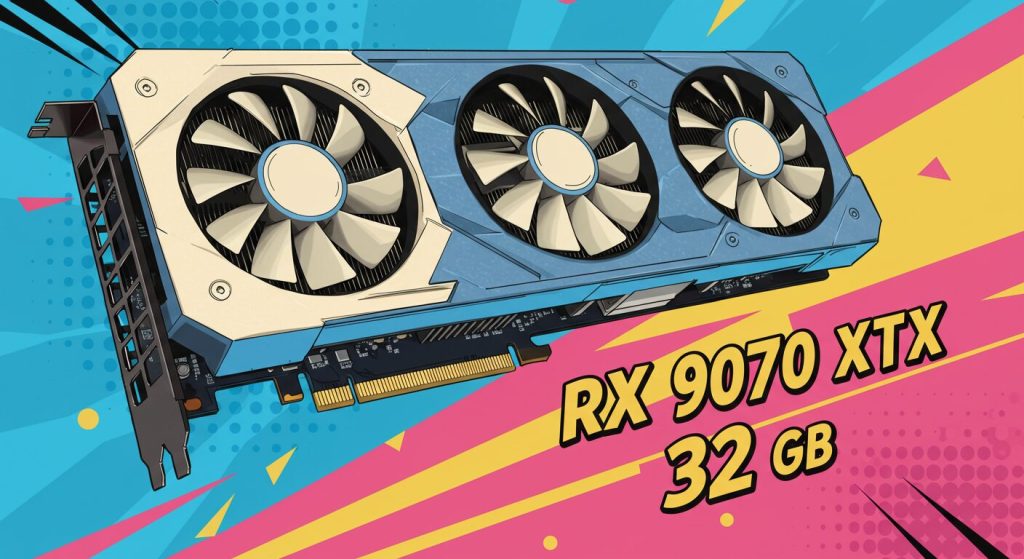
- Solving the Radeon RX 9070 XTX Enigma
- The Real RDNA 4 Leaders: Radeon RX 9070 XT & RX 9070 In-Depth
- RDNA 4 Architecture: Key Advancements
- Performance Analysis: Putting the Radeon RX 9070 XT to the Test
- FSR 4: AMD Enters the AI Upscaling Arena
- Market Reality Check: Pricing, Availability, and Reception
- The Road Ahead: Expanding the RX 9000 Family
- Conclusion: RDNA 4’s Position and the Final Word on RX 9070 XTX
- Disclaimer
Introduction
Rumors and online speculation have been swirling around a potential powerhouse graphics card: the AMD Radeon RX 9070 XTX. Given that the previous RDNA 3 generation was topped by the formidable RX 7900 XTX, many enthusiasts naturally anticipated a similar flagship for the new RDNA 4 architecture. Is AMD holding back its ultimate weapon, or is the story more complex?
AMD’s launch of the RDNA 4 architecture and the Radeon RX 9000 series marks a pivotal moment, shaking up the competitive landscape, particularly against NVIDIA’s latest RTX 50-series offerings. However, AMD’s strategy this generation involves some significant shifts.
This report cuts through the speculation to deliver a clear analysis based on the latest information available as of late April 2025. We will dissect AMD’s actual strategy for RDNA 4, investigate the truth behind the RX 9070 XTX rumors, provide a detailed breakdown of the real RDNA 4 leaders – the Radeon RX 9070 XT and Radeon RX 9070 – evaluate their performance and groundbreaking features like FSR 4, examine their turbulent market reception, and look ahead at upcoming models poised to redefine the mid-range market.
AMD’s RDNA 4 Playbook: New Strategy, New Numbers
AMD’s approach with the RDNA 4 generation involves notable strategic changes, starting with the product naming itself and extending to a refocused market target.
The Generational Leapfrog and Naming Revamp
One of the first surprises was AMD’s decision to skip the “RX 8000” series designation for its desktop RDNA 4 GPUs, jumping directly from the RX 7000 series (RDNA 3) to the RX 9000 series. This move is widely believed to reserve the 8000-series branding for mobile or APU components potentially based on an RDNA 3.5 iteration, such as those found in handheld gaming devices.
Alongside this generational jump, AMD revised its model numbering convention. The previous “xX00” format (like RX 7900) has been replaced with an “x0X0” format (like RX 9070). This change appears driven by two key strategic considerations:
- Easier NVIDIA Comparison: The new format aligns more closely with NVIDIA’s RTX 50-series lineup (e.g., RTX 5090, RTX 5070). This allows consumers, especially those less familiar with AMD’s product stack, to more intuitively grasp the intended performance tier and competitive positioning of AMD’s offerings relative to NVIDIA’s dominant market presence.
- Brand Synergy: Launching the GPUs under the RX 9000 banner creates synergy with the simultaneously announced Ryzen 9000 series CPUs. This unified branding strengthens the perception of the AMD platform as a whole, promoting consistency and potentially boosting overall brand recognition.
This new naming scheme signals AMD’s intent to make product selection clearer, particularly for mainstream buyers navigating a market heavily influenced by NVIDIA’s established conventions.
Strategic Pivot: Targeting the “Performance-Mainstream”
Perhaps the most significant strategic shift with RDNA 4 is AMD’s explicit decision to focus on the “performance-mainstream” market rather than directly challenging NVIDIA’s highest-end halo products like the RTX 5080 and RTX 5090. AMD leadership has indicated that competing at the absolute peak of performance involves immense development costs and potentially lower return on investment (ROI) compared to capturing share in the higher-volume segments.
This means prioritizing the market segment typically occupied by cards in the $500 to $600 price range, where price-to-performance is a critical purchasing factor for a larger number of gamers. The launch pricing reflects this, with the RX 9070 XT at $599 and the RX 9070 at $549, positioning them aggressively against NVIDIA’s offerings like the $749 RTX 5070 Ti and **549RTX5070∗∗.It′simportanttonotethatAMDhashintedthisfocusmightbespecifictotheRDNA4generation.Futurearchitectures,potentiallydubbed”UDNA,”couldseeAMDre−entertheultra−high−endfray.ForRDNA4,however,thestrategyisclear:delivercompellingperformanceandfeaturestothelargestpossiblesegmentofthegamingmarketataccessiblepricepoints.Thispivotrepresentsacalculatedgamble.Byconcentratingonthemainstream,AMDaimstomaximizesalesvolumeandmarketsharewhereitbelievesitcanoffersuperiorvalue(/frame). However, it risks conceding the perception of ultimate performance leadership to NVIDIA for this generation, which could have longer-term brand implications. The success of this strategy hinges entirely on AMD’s ability to deliver on its value proposition, a goal complicated by the pricing and availability issues witnessed at launch.
Solving the Radeon RX 9070 XTX Enigma
With the strategic context established, let’s address the central question: Does the Radeon RX 9070 XTX exist?
The “XTX” Expectation
The expectation for an RX 9070 XTX stems directly from the previous generation. The RDNA 3 lineup was spearheaded by the RX 7900 XTX, positioned as the ultimate performance option above the RX 7900 XT. This established “XTX” as the suffix denoting AMD’s top-tier consumer graphics card within that family. When the RX 9070 XT was announced as the RDNA 4 flagship, many naturally assumed an even more powerful “XTX” variant would follow.
Lack of Credible Evidence
Despite persistent online chatter, as of late April 2025, there is no reliable official information, credible leak, benchmark result, or regulatory filing pointing to the existence of a Radeon RX 9070 XTX model. The highest-tier RDNA 4 card officially announced and reviewed remains the Radeon RX 9070 XT.
Contradiction with Strategy
Furthermore, the very idea of an RX 9070 XTX clashes directly with AMD’s stated RDNA 4 strategy. Launching a card above the $599 RX 9070 XT would place it squarely in the ultra-high-end market (likely $750+), the very segment AMD explicitly chose not to target this generation due to ROI concerns. Introducing such a product would undermine their strategic focus on the performance-mainstream segment.
Naming Convention Shift
The shift to the “x0X0” naming scheme also diminishes the likelihood of an XTX variant carrying the 9070 number. In this new system, the “tens” digit (the ‘7’ in 9070) appears to be the primary indicator of the performance tier within the RX 9000 series. While suffixes might still be used (as seen with XT), the expectation that every tier needs an XTX variant based on past conventions seems less probable under the new system.
Verdict: A Speculative Ghost
Based on the available evidence and AMD’s declared strategy, the Radeon RX 9070 XTX appears to be a product of speculation, fueled by past naming patterns rather than any concrete product plans for the RDNA 4 generation. The Radeon RX 9070 XT is the confirmed flagship of the current lineup.
The Real RDNA 4 Leaders: Radeon RX 9070 XT & RX 9070 In-Depth
With the XTX myth dispelled, let’s focus on the actual top RDNA 4 offerings: the Radeon RX 9070 XT and RX 9070.
Core Technology: Navi 48 GPU
Both the RX 9070 XT and RX 9070 are built around the Navi 48 GPU. This chip represents the pinnacle of AMD’s RDNA 4 architecture for the consumer market at launch. Manufactured using TSMC’s advanced N4P process (a 4nm-class node), Navi 48 packs approximately 53.9 billion transistors into a die size of roughly 356.5 mm².
To create differentiation in performance and price, the RX 9070 utilizes a cut-down version of the Navi 48 silicon. While physically the same chip as in the XT model, the RX 9070 has some functional units, specifically Compute Units (CUs), disabled. This allows AMD to offer a slightly lower-performing card at a reduced price point.
Specifications Breakdown
The table below details the key specifications of the two launch GPUs, highlighting the differences stemming from the full versus cut-down Navi 48 implementation:
| Specification Item | Radeon RX 9070 XT | Radeon RX 9070 |
| Architecture/GPU | RDNA 4 / Navi 48 | RDNA 4 / Navi 48 |
| Process Technology | TSMC N4P | TSMC N4P |
| Transistors | ~53.9 Billion | ~53.9 Billion |
| Die Size | ~356.5 mm² | ~356.5 mm² |
| Compute Units (CU) | 64 | 56 |
| GPU Shaders (ALU) | 4096 | 3584 |
| Ray Tracing Cores | 64 | 56 |
| AI Cores | 128 | 112 |
| Game Clock (MHz) | 2400 | 2100 |
| Boost Clock (MHz) | Up to 2970 (~3000) | Up to 2520 (~2500) |
| VRAM Capacity | 16 GB GDDR6 | 16 GB GDDR6 |
| VRAM Speed | 20 Gbps | 20 Gbps |
| Memory Bus Width | 256-bit | 256-bit |
| L2/Infinity Cache | 64 MB | 64 MB |
| ROPs | 128 | 128 |
| TMUs | 256 | 224 |
| FP32 Perf (Boost) | ~48.7 TFLOPS | ~36.1 TFLOPS |
| FP16 Perf (Boost) | ~389 TFLOPS (Sparse) | ~289 TFLOPS (Sparse) |
| INT4 Perf (Boost) | ~1557 TOPS (Sparse) | ~1156 TOPS (Sparse) |
| Memory Bandwidth | 640 GB/s | 640 GB/s |
| Total Board Power (TBP) | 304 W | 220 W |
| Official MSRP (USD) | $599 | $549 |
(Data sourced from original Japanese text, AMD official announcements, and cross-referenced sources)
Key Spec Highlights
A crucial feature for both models is the inclusion of 16GB of GDDR6 VRAM. In an era where game VRAM requirements are steadily increasing, especially at 1440p and 4K resolutions, this generous allocation provides a significant advantage over competitors that might offer less memory (like the 12GB rumored for NVIDIA’s RTX 5070) in the same price bracket.
The differences primarily lie in the core configuration and power envelope. The RX 9070 XT boasts more Compute Units, higher clock speeds (approaching 3.0 GHz boost), and consequently higher theoretical compute performance (TFLOPS). This comes at the cost of significantly higher power consumption, with a Total Board Power (TBP) of 304W compared to the RX 9070’s more modest 220W. This difference impacts not only energy usage but also the cooling solutions required by board partners and the minimum recommended power supply unit (PSU) wattage.
RDNA 4 Architecture: Key Advancements
Beyond the core specifications, the underlying RDNA 4 architecture introduces significant improvements, particularly in areas where AMD previously lagged behind NVIDIA: ray tracing and AI acceleration.
Ray Tracing Reimagined: 3rd Generation Ray Accelerators
AMD has heavily focused on enhancing ray tracing (RT) performance in RDNA 4. The architecture features 3rd Generation Ray Accelerators, which AMD claims deliver more than double the ray tracing throughput per Compute Unit compared to the previous RDNA 3 generation.
This boost is achieved through new architectural techniques, including support for BVH8 traversal (allowing the accelerator to process wider sections of the Bounding Volume Hierarchy structure used in ray tracing calculations) and optimizations like directional bounding boxes. These advancements enable more efficient intersection testing and overall faster, higher-quality ray tracing calculations.
The significance of this improvement cannot be overstated. Historically, AMD GPUs offered significantly lower RT performance than their NVIDIA counterparts, often making demanding ray-traced effects impractical. RDNA 4 aims to close this gap substantially, making features like realistic global illumination, reflections, and shadows a much more viable option for owners of Radeon RX 9000 series cards, thus enhancing visual fidelity in modern titles that leverage these effects.
AI Gets a Boost: 2nd Generation AI Accelerators
Artificial intelligence processing capabilities have also received a major upgrade in RDNA 4 with the introduction of 2nd Generation AI Accelerators. AMD describes these as being “supercharged,” offering double the FP16 (half-precision floating-point) performance compared to RDNA 3’s AI units.
Crucially, these new accelerators add support for new, lower-precision data types like FP8, INT8, and INT4, as well as structured sparsity. These techniques allow AI models to run much faster and more efficiently by reducing the amount of data that needs to be processed and transferred, often with minimal impact on accuracy for specific tasks like inference. This enhancement results in impressive theoretical AI performance figures, such as the RX 9070 XT achieving up to 1557 TOPS (Trillions of Operations Per Second) using sparse INT4 calculations.
These significantly enhanced AI capabilities serve as the foundational hardware for AMD’s new FidelityFX Super Resolution 4 (FSR 4) upscaling technology. However, their potential extends beyond just upscaling. This hardware upgrade signals AMD’s intent to compete more broadly in AI-accelerated workloads. It opens the door for future innovations in gaming, such as AI-driven NPC behavior, physics simulations, or advanced image processing techniques. It also positions RDNA 4 GPUs to potentially handle AI tasks in content creation applications more effectively, making the architecture more versatile and future-proof as AI integration continues to grow across the computing landscape.
Performance Analysis: Putting the Radeon RX 9070 XT to the Test
Understanding the architecture and specifications is crucial, but real-world gaming performance is the ultimate measure. Based on aggregated data from AMD’s official claims, benchmarks from reputable independent reviewers (such as Gamers Nexus and Hardware Unboxed), and available performance leaks, here’s how the Radeon RX 9070 XT stacks up.
(Note: Performance can vary significantly based on the specific game, resolution, graphics settings, driver version, and test system configuration.)
Rasterization Muscle
In traditional rasterization performance, which remains the foundation for most games, the RX 9070 XT proves to be a very potent card for its intended price class.
- vs. NVIDIA RTX 5070 Ti ($749 MSRP): Across various titles at 1440p and 4K resolutions, the RX 9070 XT generally trades blows with the significantly more expensive RTX 5070 Ti. In some games, the AMD card pulls slightly ahead, while in others, the NVIDIA card leads by a small margin. On average, they offer comparable rasterization performance. This makes the RX 9070 XT’s $599 MSRP extremely compelling from a price/performance perspective, assuming that price can be achieved in the retail market.
- vs. NVIDIA RTX 5070 ($549 MSRP): Reviews indicate that the RX 9070 XT clearly outperforms the RTX 5070 in rasterization tasks.
- vs. AMD RX 7900 XTX (RDNA 3 Flagship): The previous generation’s flagship, with its higher CU count (96 vs. 64) and wider memory bus (384-bit vs. 256-bit), often maintains a lead over the RX 9070 XT, particularly in scenarios that are less GPU-bound or heavily reliant on memory bandwidth. However, the performance gap is generally considered smaller than typical generational uplifts, highlighting the efficiency gains of RDNA 4.
- vs. AMD RX 7900 GRE / RX 7900 XT: The RX 9070 XT offers a significant performance uplift compared to these RDNA 3 cards. AMD claimed average performance gains of 42% at 4K and 38% at 1440p over the RX 7900 GRE, a comparison point they emphasized in marketing. It also comfortably surpasses the RX 7900 XT.
In summary, the RX 9070 XT delivers flagship-level rasterization performance that challenges NVIDIA’s more expensive offerings, making it an excellent value proposition based purely on its MSRP.
Ray Tracing Capabilities
Thanks to the architectural improvements in RDNA 4, ray tracing performance sees a dramatic improvement compared to the previous generation. AMD claimed an average RT performance uplift of around 53% at 4K and 49% at 1440p compared to the RX 7900 GRE. Independent reviews confirm this substantial progress, making ray tracing a much more practical and enjoyable feature on AMD hardware than ever before.
However, comparisons with NVIDIA still reveal a gap, albeit a narrower one:
- vs. NVIDIA RTX 5070 Ti: While the RX 9070 XT gets much closer, the RTX 5070 Ti generally still holds an advantage in demanding ray tracing scenarios. In heavily ray-traced games like Cyberpunk 2077 with RT Ultra settings or path tracing enabled, the RTX 5070 Ti typically provides noticeably higher frame rates. Reviews suggest an average advantage for the RTX 5070 Ti ranging from 10% to 25% in RT workloads, though some less demanding titles might show near parity or even a slight edge for the RX 9070 XT.
- vs. NVIDIA RTX 5070: In ray tracing, the RX 9070 XT often matches or slightly exceeds the performance of the RTX 5070.
The conclusion here is that while the RX 9070 XT’s ray tracing capabilities are a massive leap forward for AMD, allowing for comfortable RT experiences in many games, NVIDIA’s RTX 5070 Ti still generally maintains leadership in this specific area within the same performance tier. The gap has shrunk significantly, but it persists in the most demanding RT implementations.
Relative Performance Summary
The following table provides an estimated summary of the RX 9070 XT’s relative performance against key competitors and predecessors, based on aggregated data from reviews and AMD’s claims. These are averages and estimates; actual performance will vary.
| Comparison GPU | 1440p Raster (Avg %) | 4K Raster (Avg %) | 1440p RT (Avg %) | 4K RT (Avg %) |
| RX 9070 XT | 100% | 100% | 100% | 100% |
| RX 9070 | ~88-91% | ~87-90% | ~85-88% | ~85-88% |
| RX 7900 XTX | ~105-110% | ~103-108% | ~80-90% | ~80-90% |
| RX 7900 GRE | ~70-75% | ~68-73% | ~60-65% | ~58-63% |
| Nvidia RTX 5070 Ti | ~97-103% | ~95-102% | ~110-125% | ~110-125% |
| Nvidia RTX 5070 | ~80-85% | ~78-83% | ~85-95% | ~85-95% |
(Estimates based on aggregated data from multiple review sources and AMD official claims)
FSR 4: AMD Enters the AI Upscaling Arena
One of the most exciting technological advancements accompanying the RDNA 4 launch is FidelityFX Super Resolution 4 (FSR 4), AMD’s next-generation upscaling technology.
The Leap to Machine Learning
FSR 4 represents a fundamental shift from its predecessors (FSR 1 through 3.1), which relied primarily on spatial and temporal algorithms. Instead, FSR 4 embraces Machine Learning (ML), utilizing techniques like Convolutional Neural Networks (CNNs) to reconstruct higher-resolution images from lower-resolution inputs. This approach mirrors NVIDIA’s DLSS technology.
Hardware Dependency and Exclusivity
This move to ML necessitates significant computational power, specifically leveraging the enhanced 2nd Generation AI Accelerators present in RDNA 4 GPUs (including support for Wide Matrix Multiply Accumulate (WMMA) operations and FP8 data types). Consequently, at launch, FSR 4 is exclusive to the Radeon RX 9000 series GPUs. This hardware dependency marks a departure from the broader compatibility of earlier FSR versions. There have also been suggestions of shared development or technological links between FSR 4 and Sony’s PSSR (PlayStation Spectral Super Resolution) technology used in the PS5 Pro, given the close hardware relationship.
Image Quality & Performance Compared
Technical analyses, including those from outlets like Digital Foundry, indicate that FSR 4 delivers a dramatic improvement in image quality compared to FSR 3.1. Key weaknesses of previous FSR iterations, such as noticeable ghosting artifacts on moving objects and temporal instability (flickering or shimmering), appear to be significantly mitigated or eliminated.
When compared against NVIDIA’s DLSS:
- vs. Older DLSS (CNN-based, e.g., DLSS 2.x/3.x): FSR 4 is generally considered to offer superior image quality to these older DLSS iterations.
- vs. Latest DLSS (Transformer-based, e.g., DLSS 4): NVIDIA’s most recent DLSS technology, which employs more advanced Transformer models, likely still holds an edge in areas like fine detail preservation and the quality of anti-aliasing, particularly at lower input resolutions. However, the consensus is that FSR 4 has significantly narrowed the quality gap.
Regarding performance impact, the ML-based approach of FSR 4 may come with a slightly higher computational cost (resulting in a marginally lower FPS uplift for a given quality preset) compared to FSR 3.1 or older DLSS versions. This is a trend also observed with NVIDIA’s more complex Transformer-based DLSS models.
It’s also important to note that FSR 4’s upscaling component can be combined with the existing FSR 3.1 Frame Generation technology. While FSR’s frame generation can sometimes offer higher performance gains than DLSS Frame Generation, it has often been criticized for introducing more noticeable visual artifacts.
Limitations and Adoption
The primary limitation of FSR 4 at launch is its exclusivity to RDNA 4 hardware. This restricts its potential user base compared to DLSS, which is available across multiple generations of NVIDIA RTX GPUs (though specific features like Frame Generation also have hardware requirements).
Game adoption is the other critical factor. While AMD announced support in over 30 titles at launch with a target of 75+ in the future, widespread success depends on developers actively integrating the technology. There is a possibility, however, that FSR 4 might be enabled via driver-level overrides in some existing FSR 3.1 titles, potentially expanding its reach more quickly.
The move to ML significantly elevates FSR’s image quality, making it a highly competitive upscaling solution. However, the RDNA 4 hardware requirement means it primarily serves to strengthen the AMD ecosystem for new buyers, rather than acting as a feature that can pull existing RTX users away from the established DLSS base. Its long-term impact hinges on rapid game adoption and consistently demonstrating near-DLSS quality in independent testing.
Market Reality Check: Pricing, Availability, and Reception
Despite the promising technology and aggressive positioning on paper, the launch of the Radeon RX 9070 XT and RX 9070 was marred by significant market challenges.
MSRP vs. Street Price Nightmare
AMD generated considerable excitement by announcing compelling Manufacturer’s Suggested Retail Prices (MSRPs): $599 for the RX 9070 XT and $549 for the RX 9070. These prices positioned the cards very favorably against their NVIDIA competitors.
However, reality struck hard on the March 6, 2025, launch day. Consumers worldwide were met with severe stock shortages and retail prices that vastly exceeded the MSRP. Reports flooded in of the $599 RX 9070 XT being sold for anywhere between $700 and over $1000 by retailers and on secondary markets. Listings on major retailers like Amazon and Newegg reflected these inflated prices shortly after launch.
Retailers themselves warned that the initial batches available at MSRP would be extremely limited and likely sell out almost instantly, with prices expected to rise thereafter. While some reports suggested prices began to normalize closer to MSRP in specific regions like Germany weeks after launch, many areas continued to see persistent stock issues and elevated pricing well into April 2025. User reviews often expressed frustration, explicitly calling out the discrepancy between the advertised MSRP and the actual purchase price.
This massive disconnect effectively turned the launch into a “paper launch” for many potential buyers. The core value proposition – high performance at a competitive price – was immediately undermined by the inability to purchase the cards anywhere near their intended MSRP. This situation benefited scalpers and retailers charging significant premiums, while frustrating consumers and potentially damaging AMD’s credibility regarding launch pricing. It raised questions about AMD’s supply chain management, demand forecasting, or perhaps an initial MSRP that was set unrealistically low for market conditions.
Demand Dynamics
Paradoxically, despite the pricing chaos, market demand for the Radeon RX 9070 series, particularly the XT model, was exceptionally strong.
AMD CEO Dr. Lisa Su claimed the launch was a massive success, stating that initial sales significantly outpaced previous generations (though specific figures like “200,000 units sold” were later clarified or walked back, possibly referring to initial shipments to partners rather than end-user sales). User reports and retailer stock trackers confirmed that even at inflated prices, the cards were selling out rapidly. In some markets, like Japan, reports suggested the RX 9000 series captured a significant initial market share.
This high demand, even amidst inflated pricing, likely stemmed from several factors: the genuinely strong rasterization performance offered, pent-up demand from gamers waiting for a new generation, and perhaps some dissatisfaction among enthusiasts with NVIDIA’s own pricing strategies or perceived generational performance gains in the competing RTX 50-series.
Partner Landscape Changes
Adding another layer of complexity to the launch was a significant shift in the Add-In Board (AIB) partner landscape. MSI, a major global GPU vendor and long-time AMD partner for the RX 5000, 6000, and 7000 series, made the surprising decision not to manufacture any Radeon RX 9000 series cards.
While MSI hasn’t publicly detailed its reasoning, industry observers speculate several contributing factors:
- Prioritizing NVIDIA: MSI has a very strong relationship with NVIDIA, whose GPUs command a much larger market share (around 83% according to Steam surveys). The NVIDIA business is likely more profitable for MSI.
- Profit Margins: AMD cards might offer lower profit margins for AIB partners compared to NVIDIA equivalents.
- MSRP Uncertainty: Rumors suggested potential delays or last-minute changes in AMD’s final MSRP decisions, which could have complicated partner planning and cost calculations.
- Market Dynamics: The exit of EVGA (a major NVIDIA-exclusive partner) from the GPU market might have created opportunities for MSI to further strengthen its ties with NVIDIA.
While MSI stepped back, other prominent AMD partners, including Asus, Gigabyte, PowerColor, Sapphire, XFX, and ASRock, proceeded with launching custom RX 9070 XT and RX 9070 models. MSI’s decision, however, highlights the complex business realities behind GPU launches, where strategic partnerships and profit considerations can sometimes outweigh the market success of the underlying product.
The Road Ahead: Expanding the RX 9000 Family
Following the launch of the RX 9070 XT and RX 9070, AMD appears poised to expand the RDNA 4 lineup, targeting different price points and market segments.
Radeon RX 9070 GRE: The China-Focused Curveball
Shortly after the main launch, rumors of a Radeon RX 9070 GRE (Great Radeon Edition) began circulating, culminating in an official launch exclusive to the Chinese market in late April/early May 2025. Pre-orders went live towards the end of April, with retail availability starting around May 8th.
The RX 9070 GRE is designed to slot between the RX 9070 and the upcoming RX 9060 XT. Its specifications confirm it uses a further cut-down Navi 48 XL GPU:
- Compute Units: 48 (vs. 56 on RX 9070, 64 on RX 9070 XT)
- Stream Processors: 3072
- Memory: 12GB GDDR6 (vs. 16GB on RX 9070/XT)
- Memory Bus: 192-bit (vs. 256-bit on RX 9070/XT)
- Memory Speed: 18 Gbps (vs. 20 Gbps on RX 9070/XT)
- Boost Clock: Up to 2.79 GHz (higher than RX 9070’s 2.52 GHz)
- TBP: 220W (same as RX 9070)
- Power Connectors: Typically dual 8-pin
AMD officially claims the RX 9070 GRE is, on average, 6% faster than the previous generation’s RX 7900 GRE in a suite of 30 games tested at 1440p Ultra settings. This positions it as a capable 1440p gaming card, likely performing slightly below the standard RX 9070 due to the reduced core count and significantly lower memory bandwidth (432 GB/s vs. 640 GB/s), despite its higher boost clock. Performance relative to NVIDIA’s RTX 5070 is expected to be close in rasterization, though the NVIDIA card might hold an edge in RT, and the GRE has less VRAM than the standard RX 9070.
The existence of the GRE is likely driven by chip binning – utilizing Navi 48 dies that have functional compute units but defects in parts of the memory controller or cache, preventing them from being used as full RX 9070/XT parts.
Its launch pricing in China was around ¥4199 RMB (roughly $575 USD, though direct conversion isn’t indicative of potential global pricing), only slightly below the RX 9070’s launch MSRP in that region. This led to speculation that the GRE might effectively replace the standard RX 9070 in the Chinese market. While initially rumored for a Q4 2025 global release, its future availability outside China remains uncertain as of late April 2025.
Radeon RX 9060 XT (8GB & 16GB): AMD’s Mid-Range Offensive
Arguably the most critical upcoming launch for AMD’s RDNA 4 strategy is the Radeon RX 9060 XT, targeting the high-volume mid-range market. This card was teased by AMD during the initial RX 9000 series reveal.
Rumored specifications suggest it will be based on a new, smaller Navi 44 GPU:
- Compute Units: Likely 32 (resulting in 2048 Stream Processors)
- Clock Speeds: Potentially exceeding 3.2 GHz boost
- Memory: Expected in both 8GB and 16GB GDDR6 variants
- Memory Bus: 128-bit
- Memory Speed: Possibly 20 Gbps
- PCIe Interface: PCIe 5.0 x8
The RX 9060 XT is anticipated to compete directly against NVIDIA’s RTX 5060 and RTX 5060 Ti in the $300-$400 price bracket. Launch timing rumors have converged around mid-to-late May 2025. Several sources pointed towards a May 18th launch, while others suggested a May 21st announcement during AMD’s Computex keynote, with retail availability following in June. This timing appears strategically chosen to directly counter NVIDIA’s rumored launch window for the RTX 5060 series (around May 19th).
The decision to offer both 8GB and 16GB variants is significant. The 8GB model allows AMD to hit a lower price point, crucial for the budget-conscious mid-range segment. However, 8GB is increasingly seen as insufficient for future-proofing in modern games at higher settings, potentially drawing criticism. The 16GB model addresses these VRAM concerns, offering better longevity, but will inevitably come at a higher price. This mirrors NVIDIA’s strategy with the RTX 5060 Ti, reflecting the intense competition and sensitivity around VRAM capacity in this market segment.
The success of the RX 9060 XT is pivotal for AMD’s goal of capturing significant market share in the performance-mainstream segment. Its competitiveness will hinge on the performance delivered by both variants relative to their price points, particularly how the 16GB model stacks up against the RTX 5060 Ti 16GB, and whether the 8GB model offers enough value to overcome its VRAM limitations compared to the RTX 5060 8GB.
Conclusion: RDNA 4’s Position and the Final Word on RX 9070 XTX
AMD’s Radeon RX 9000 series launch, powered by the RDNA 4 architecture, represents a significant strategic shift and technological advancement, albeit one accompanied by considerable market turbulence.
- The RX 9070 XTX Myth: Based on current evidence and AMD’s stated strategy, the Radeon RX 9070 XTX is not part of the RDNA 4 lineup. It remains a phantom product born from expectations based on previous naming conventions.
- The Real Flagship – RX 9070 XT: The Radeon RX 9070 XT emerges as the actual RDNA 4 leader at launch. On paper, its $599 MSRP offers compelling value, delivering rasterization performance competitive with NVIDIA’s more expensive RTX 5070 Ti.
- Architectural Gains: RDNA 4 brings substantial improvements, most notably drastically enhanced ray tracing performance that makes the feature viable on AMD hardware, and the introduction of FSR 4, a promising AI-based upscaling technology that significantly closes the quality gap with DLSS, albeit with RDNA 4 hardware exclusivity.
- Strategic Focus: AMD deliberately pivoted away from the ultra-high-end for this generation, concentrating its efforts on the high-volume performance-mainstream market ($500-$600 price range) where it aims to maximize market share through strong price/performance.
- Market Challenges: This strategy was significantly hampered at launch by severe supply shortages and retail prices far exceeding MSRP, undermining the intended value proposition for early adopters. While demand proved strong, the inability to deliver product at the target price point remains a major issue.
- Future Prospects: The niche Radeon RX 9070 GRE (initially China-exclusive) fills a gap using binned chips, but the true test of AMD’s RDNA 4 strategy likely lies with the upcoming mid-range Radeon RX 9060 XT (8GB/16GB). Its success in the crucial $300-$400 segment against NVIDIA’s RTX 5060 series will be critical for AMD’s market share ambitions.
AMD’s RDNA 4 gamble on the mainstream is bold. The technology itself, particularly the RX 9070 XT, offers impressive performance potential for its intended price. If supply stabilizes and retail prices eventually fall closer to MSRP, the RX 9070 XT and RX 9070 could become highly attractive options for gamers seeking excellent 1440p and capable 4K performance without paying NVIDIA’s highest premiums. However, the initial launch fumbles have cast a shadow. Ultimately, the success of RDNA 4 may hinge less on its current flagships and more on the performance, pricing, and availability of the upcoming RX 9060 XT models as they battle for dominance in the heart of the PC gaming market. Continued monitoring of market prices, stock levels, and the performance benchmarks of these future releases will be essential.
Disclaimer
This report is based on publicly available information, including official announcements, third-party reviews, industry reports, and rumors circulating as of late April 2025. Information based on leaks or rumors should be treated as unverified until officially confirmed or substantiated by independent testing. Graphics card performance benchmarks can vary significantly depending on the test system configuration, software drivers, game titles, and specific settings used. Market conditions, including product pricing and availability, are subject to rapid change.


コメント